
How to Choose a Hair Transplant Surgeon
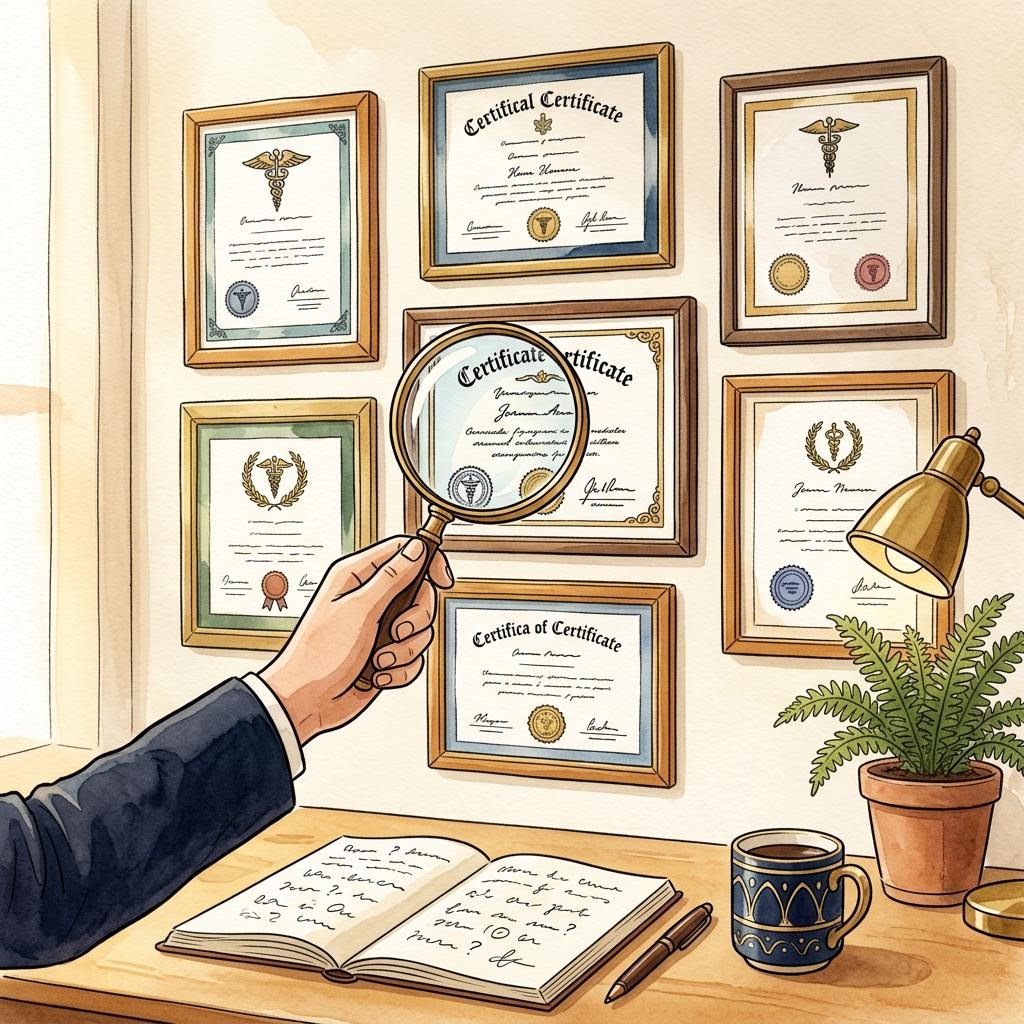
The technique matters less than who performs it.
FUE and FUT are both well established. What separates a result that looks natural in fifteen years from one that does not is judgement: how the case was assessed, where the hairline was placed, how the donor area was harvested, how many grafts were used and whether operating was the right call at all.
None of that is visible in a price comparison. This page covers what is actually worth establishing.
Training and experience
Hair restoration is a distinct area of practice. General surgical training does not automatically confer expertise in it, and nor does experience in unrelated cosmetic procedures.
Worth asking:
- What is your training, and how much of it relates specifically to hair restoration?
- How long have you been performing hair transplant surgery?
- Roughly how many procedures do you perform, and over what period?
- Do you perform both FUE and FUT?
That last question is more revealing than it appears. A practitioner who offers only one technique will tend to recommend it for every case, because it is the only thing they can offer. Someone who performs both can genuinely assess which suits your donor area, your hair length preference and the graft numbers you need.
Dr Jassim Daood has practised for over 30 years across Australia, New Zealand, the United States and Europe, and performs both techniques.
Registration and titles
In Australia, medical practitioners are registered with AHPRA, and the register is public. You can look up any practitioner and confirm their registration status and type.
Some titles are protected and can only be used by practitioners holding specialist registration in that field. Where a practitioner holds general registration, that is what should be stated.
Dr Daood is a registered medical practitioner with general registration, MED0000952762.
The practical point is that you can verify this independently rather than taking a website's word for it.
Professional memberships
Membership of a relevant professional body indicates ongoing engagement with the field: conferences, continuing education, exposure to how the practice is developing.
Dr Daood is a member of the International Society of Hair Restoration Surgery.
Memberships are worth checking rather than assuming, and worth asking what the membership actually requires.
Who physically performs the procedure
This is one of the most important questions and one of the least often asked.
In hair transplant surgery, different steps may be carried out by different members of a team. Ask specifically:
- Who assesses my scalp and designs the hairline?
- Who performs the graft harvesting?
- Who creates the recipient sites?
- Who places the grafts?
- Will the surgeon I am consulting with be present throughout?
There is nothing inherently wrong with a team approach. It is standard in larger sessions and often necessary. What matters is that you know who is doing what, and that the clinical judgement steps, particularly hairline design and harvesting strategy, sit with the surgeon.
If the answer is vague, ask again.
Whether the clinic is focused on hair restoration
A practice where hair restoration is a core activity tends to accumulate more relevant experience than one where it sits alongside a long list of unrelated procedures.
This is not a hard rule. Plenty of practitioners work competently across several areas. But it is reasonable to ask how central hair restoration is to the practice, and how often these procedures are performed.
How the consultation is conducted
The consultation itself tells you a great deal.
Signs of a thorough assessment:
- Your scalp is examined, including the donor area, under magnification
- Your medical history is taken properly, including medications and supplements
- The likely cause of your hair loss is discussed, not assumed
- Donor supply is assessed and its limits explained
- Risks and complications are raised without you having to ask
- Graft numbers are estimated after examination, not before
- The possibility that surgery is not appropriate is genuinely on the table
- You leave with a written quote and no pressure to commit
The last point matters. A consultation should leave you free to say no, think about it, or seek another opinion. If you feel pushed towards a decision on the day, that is information.
See questions to ask at your consultation.
Transparency on cost
You should receive a written quote that states the total cost, including the surgeon's fee, anaesthesia, facility fees and aftercare.
A per-graft figure without context is difficult to compare. A headline price with separate charges added later can end up higher than a clearer quote that looked more expensive.
Ask what is included. Ask what happens if a second session is needed. Ask whether follow-up appointments are covered.
See hair transplant cost in Sydney.
Realistic conversation about outcomes
A transplant redistributes a finite supply of hair. It does not restore the density you had at twenty, and results vary between individuals for reasons including genetics, general health and donor characteristics.
A surgeon willing to say that plainly is more useful than one who is not.
Similarly, a surgeon who tells you the timeline honestly, that transplanted hair sheds within weeks and the final result takes twelve to eighteen months, is setting you up to be satisfied rather than alarmed.
Aftercare and follow-up
Results develop over more than a year. Ask what happens during that time.
- What follow-up appointments are included?
- Who do I contact if something concerns me at week three?
- What happens if a complication develops?
- What is the position if the result falls short of what was discussed?
These questions matter more for procedures performed a long way from home, which is worth weighing if you are considering travelling for surgery.
On price as a deciding factor
Two things are worth saying plainly.
The first is that judgement is not improved by being cheaper. Where to place a hairline, how much donor area to harvest and whether to operate are the decisions that determine your outcome, and they are not commodity inputs.
The second is that donor hair is finite. A poorly planned procedure does not just produce a disappointing result. It consumes supply that cannot be recovered, which constrains what any subsequent surgeon can do. Corrective work is harder and more expensive than doing it properly once.
That is not an argument for paying the most. It is an argument for understanding what you are paying for.
A practical shortlist
Reasonable things to have established before committing:
- The surgeon's training and specific experience in hair restoration
- Their AHPRA registration, verified independently
- Whether they perform both FUE and FUT
- Who performs each step of the procedure
- That your scalp and donor area were examined properly
- That the likely cause of your loss was discussed
- That risks were raised without prompting
- A written quote covering total cost
- What follow-up looks like over twelve to eighteen months
- That you felt free to decline
Second opinions
Getting a second opinion is sensible for any elective surgical procedure, and no reasonable practitioner should be troubled by it.
If two surgeons give you materially different assessments, particularly about suitability or graft numbers, that is worth understanding rather than simply going with the more encouraging answer.
Our approach
Dr Daood examines both the recipient and donor areas at consultation, discusses your medical history, and recommends an approach based on what he finds. That includes telling patients when surgery is not appropriate, or not appropriate yet, which for younger patients with progressing loss is a realistic outcome.
A GP referral is required before a cosmetic surgery consultation.
Every surgical procedure carries risk. Read our risks and complications page before deciding.
Book a consultation, or read more about Dr Jassim Daood and our team.
Related reading: are you a suitable candidate, hair transplant surgery in Sydney: the complete guide, FUE vs FUT.
This article is general information only and is not medical advice. Any surgical or invasive procedure carries risks. Suitability, risks and outcomes vary between individuals and are assessed at an individual consultation. Before proceeding, you should seek a second opinion from an appropriately qualified health practitioner.
Discuss your own case
Whether any of this applies to you can only be assessed in person. A consultation with Dr Daood at the Bankstown clinic covers your suitability, the options, the risks and written costs.