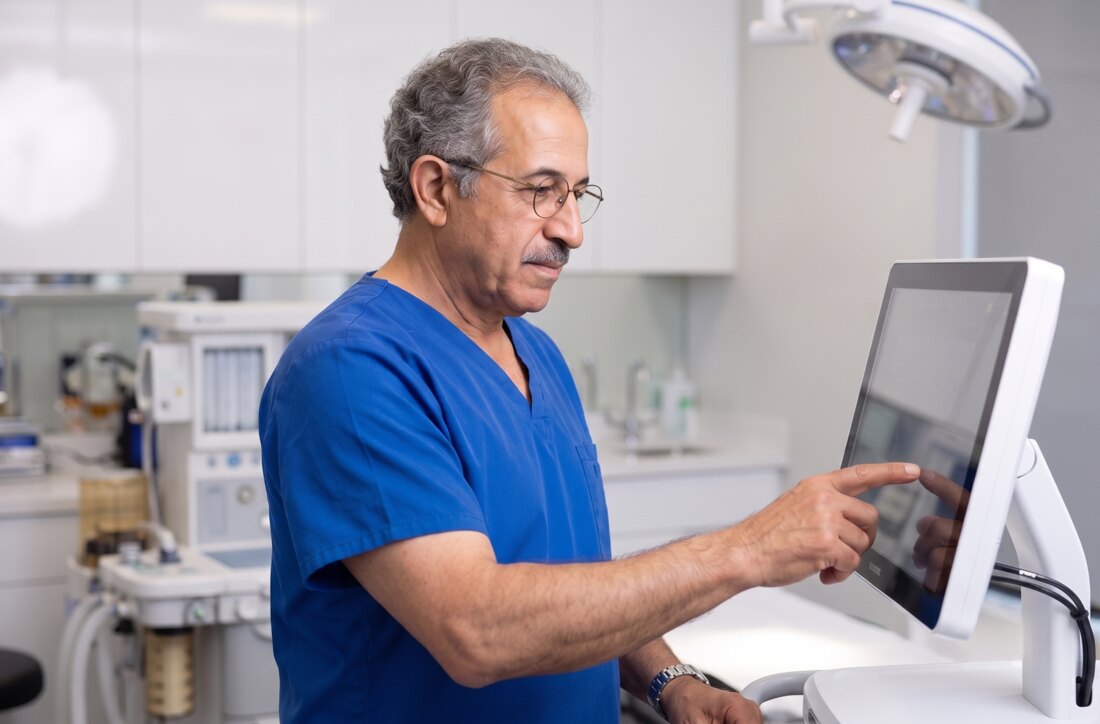
Planning a natural-looking hairline is the foundation of a hair transplant. Learn how Dr Daood maps the frontal hairline before any graft is placed.
About the procedure
What this procedure involves
Hairline design is the planning stage of a hair transplant in which the position, shape and density gradient of the new frontal hairline are mapped before any grafts are placed. Dr Jassim Daood plans each hairline individually at the Bankstown clinic, balancing the appearance you want now against how your hair loss may progress in future.
Recovery
Recovery after hairline work follows the usual FUE pattern: short-term redness, scabbing and swelling at the front of the scalp, shedding of the transplanted hairs in the first weeks, then gradual regrowth over many months.
In depth
More about this procedure
Detailed information about this procedure. Select a section to read more.
The frontal hairline is the part of a hair transplant that other people actually see. A hairline that sits too low, runs too straight or ignores the way hair naturally changes with age tends to look artificial, no matter how well the grafts grow.
For that reason Dr Daood treats hairline planning as a separate design step that happens before any graft is placed, taking into account your age, face shape, the pattern of your hair loss and how it may progress over time.
At the consultation the proposed hairline is drawn directly on your scalp so you can see its position, height and shape in the mirror and discuss adjustments before anything is decided. Reference points such as the position of your brow, temples and crown help keep the line in proportion with your face.
A natural hairline is not a solid line. The front edge is made of soft, irregular single-hair grafts, with density building gradually behind it. The angle and direction of each graft is planned so the transplanted hair lies the way your existing hair grows.
Hair loss usually continues after a transplant, so a hairline that flatters a face at thirty needs to remain believable at fifty. Dr Daood generally advises a conservative position that preserves donor hair for possible future sessions, rather than chasing the lowest possible line.
How your remaining hair may behave over time, and whether staged sessions are sensible in your case, is discussed openly at the consultation so you can weigh the trade-offs before deciding.
Common questions
Frequently asked questions
Mostly the design: an irregular front edge of single-hair grafts, a gradual build-up of density behind it, graft angles that match natural growth, and a position that suits your face and age. These choices are made at the planning stage.
The position is agreed together at the consultation. Dr Daood draws the proposed line on your scalp and explains what is realistic given your donor hair and likely future loss. A very low line is usually advised against because ongoing loss can leave it looking isolated.
No. It is the planning stage of an FUE hair transplant. The design is agreed at your consultation and then carried out as part of the transplant itself.
Ongoing loss is expected in most patterns of hair loss, which is why the design is kept conservative and donor hair is preserved where possible. Options for managing future change are discussed at your consultation.